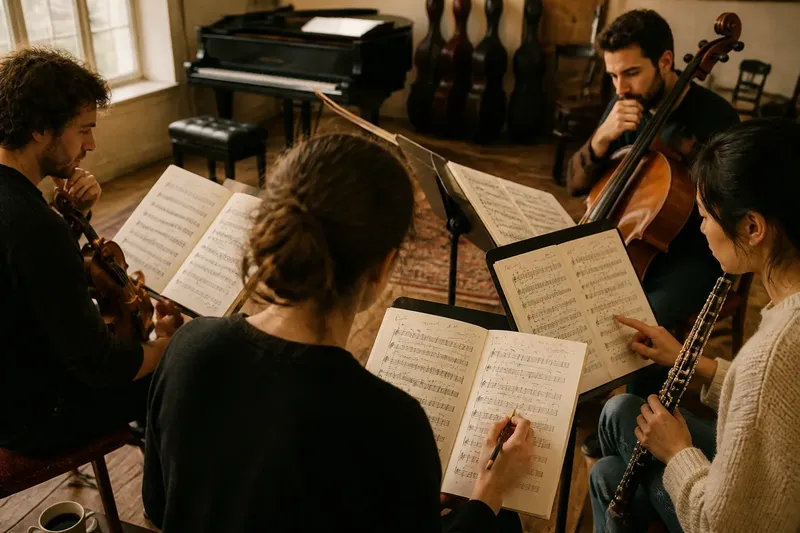
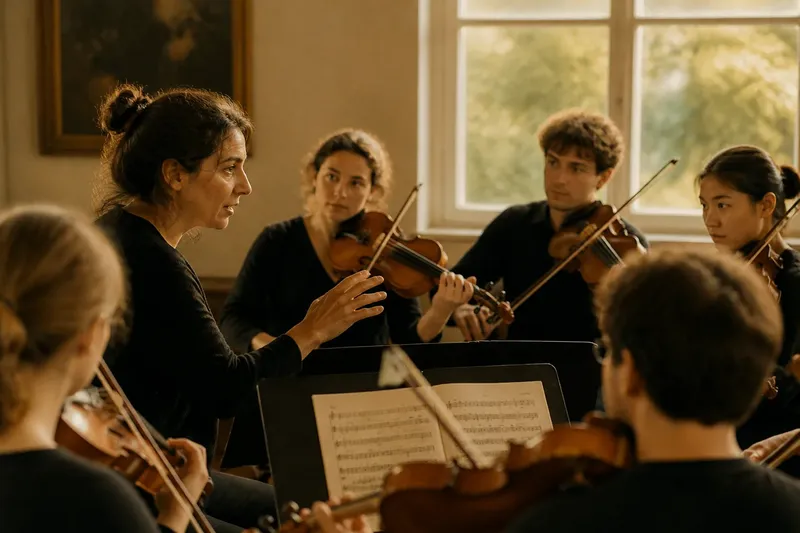
A Chamber Group’s Last Rehearsal Before a Concert
Plan a chamber group’s last rehearsal before a concert around decisions that still matter, so players leave with clear priorities and settled stage arrangements.
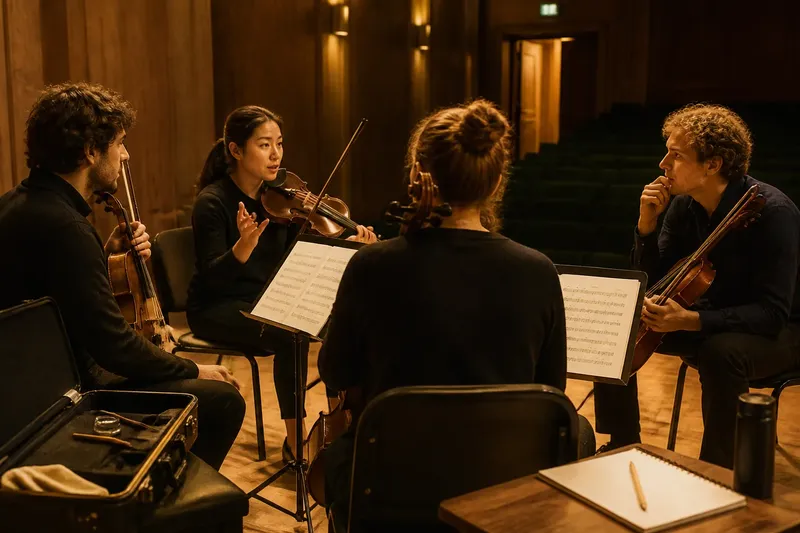
At the last rehearsal before a concert, a chamber group can spend its remaining time refining a settled phrase—or decide who carries the spare part and where the players will stand. A chamber group’s last rehearsal before a concert is most useful when it resolves decisions that cannot be postponed until the players are on stage.
Say a quartet has one evening left. The music is prepared, but no one has confirmed whether the venue provides music stands, and the players disagree about whether to repeat a short passage after a stumble. Those are different questions: one needs a practical answer, the other needs an agreed performance policy. Sorting them separately keeps the rehearsal from turning into another broad run-through.
Which decisions still belong in the final rehearsal?
Separate concert logistics, performance conventions and musical preferences. Logistics include score order, seating, stage entry and who brings any equipment. Performance conventions include what the group does after a missed entrance or an unexpected interruption. Musical preferences concern interpretation that is already settled.
Write down only matters that need a shared decision. For each one, record the question, who must answer it and the observable result that will settle it. “Confirm whether the hall has four stands; if not, assign who brings each stand” is more useful than “sort out the stage”.
Use this decision list, and choose the action that follows each result:
- Check whether the venue has enough music stands; if it does, confirm their placement, and if it does not, assign players to bring stands.
- Check whether each player has the concert version of every part; if all copies match, keep them, and if one differs, replace or correct it before the run-through.
- Check whether the stage entrance route is clear; if it is, agree who enters first, and if it is not, ask the venue contact to clarify the route.
- Check whether a page turn interrupts a player’s part; if it does not, leave the layout alone, and if it does, arrange a page-turner or prepare a suitable alternative copy.
- Check whether the group has an agreed response to a missed entrance; if it does, state it briefly, and if it does not, choose a shared place to rejoin.
- Check whether the concert order and any interval are confirmed; if they are, place the parts in that order, and if they are not, confirm the running order with the organiser.
Think of this list like packing a case: each item either has a place or needs an owner. Do not add a musical debate simply because there is time to fill.
How should the group decide what to leave unchanged?
Ask whether a proposed change solves a problem the whole group can hear or see. If it affects coordination, stage readiness or a player’s ability to take part comfortably, discuss it. If it is a fresh preference about a phrase that has been working, leave it alone unless the players can identify a clear reason to change.
Keep the decision simple. State the existing choice, the suggested alternative and what the group would listen for. Try the alternative once only if it addresses a specific concern; then choose one version and mark it lightly in the parts if needed. Avoid switching back and forth without a clear distinction to judge.
Imagine a quartet has agreed to begin a slow movement quietly, but one player worries that the opening will not carry in the hall. The group plays the opening at its established level from the planned seating. If the players can hear the lead line and respond to it, they keep the interpretation; if the line is obscured, they agree on a modest adjustment and mark it in all relevant parts. The decision is based on a shared listening result, not a general feeling that something might be wrong.
What should the group agree about interruptions?
A concert can be interrupted by a missed entrance, a broken string or an external disturbance. The group does not need a complicated emergency plan. It does need to know whether it will continue, pause or return at an agreed point in the music.
Discuss only scenarios that call for a different response. For an isolated missed entrance, agree whether the player should rejoin at the next shared phrase rather than prompting a restart. For an equipment problem that prevents a player continuing, decide who will signal a pause and who will speak to the audience if necessary. Venue staff can advise on practical arrangements; consult them rather than improvising around an unfamiliar stage procedure.
Keep any agreed response short enough to remember. A rule such as “continue to the next shared phrase unless a player cannot continue” gives everyone a clear default without adding a chain of cues to remember.
How can the group check its stage arrangements?
Use the actual venue if it is available. Otherwise, confirm details with the organiser and rehearse the decisions that depend on them. Check where cases can be left, how players enter, where stands go and whether the stage layout leaves enough room for bows, instruments and page turns.
Walk the entrance and seating order without instruments if movement is unfamiliar. Then sit or stand in the planned positions and check sightlines: can each player see the colleagues whose breathing or movement matters? If a stand blocks a view, adjust its position before playing.
Confirm who brings any agreed equipment, including pencils, spare parts, a page-turner or a tablet charger if the group uses digital scores. Name an owner for each item. “Someone should bring a charger” is not a plan; assigning it to one player is.
What should players ask before concert day?
Should the group change a settled interpretation?
Only if the players can identify a specific problem that affects the performance. If the concern is a new preference rather than a coordination or clarity issue, retain the established choice.
What should happen after a missed entrance?
Agree on a simple default, such as continuing and rejoining at the next shared phrase. If the group cannot continue safely or musically, decide who gives the signal to pause.
Who should confirm the venue arrangements?
Assign one player to contact the organiser about access, stands and stage layout. If the venue has a technical or stage manager, ask that person about unfamiliar procedures.
What belongs on the final rehearsal note?
Record only decisions players need to act on: the running order, equipment owners, any agreed response to an interruption and changes that affect the parts. Leave out discussion that has no consequence for the concert.
When is the rehearsal ready to end?
End when the remaining decisions have an owner or a clear answer, not when every player has run out of things to say. Confirm the concert order, equipment responsibilities and any agreed interruption policy. Then make one calm pass through the music only if it will check a specific unresolved matter.
For the quartet in the example, the final note can state that the opening remains unchanged, one player will bring the missing stand if the venue confirms it has none, and the group will continue after an isolated missed entrance. Those decisions are concrete and easy to carry into the concert.
A chamber group’s last rehearsal before a concert should leave players with fewer open questions, not a new layer of instructions. Keep the final note short, give every practical task an owner and stop once the decisions can be acted on. That leaves attention free for listening to one another when the performance begins.